AI-Driven Obfuscation is Rising in Mobile Malware, but Zimperium Stays Ahead
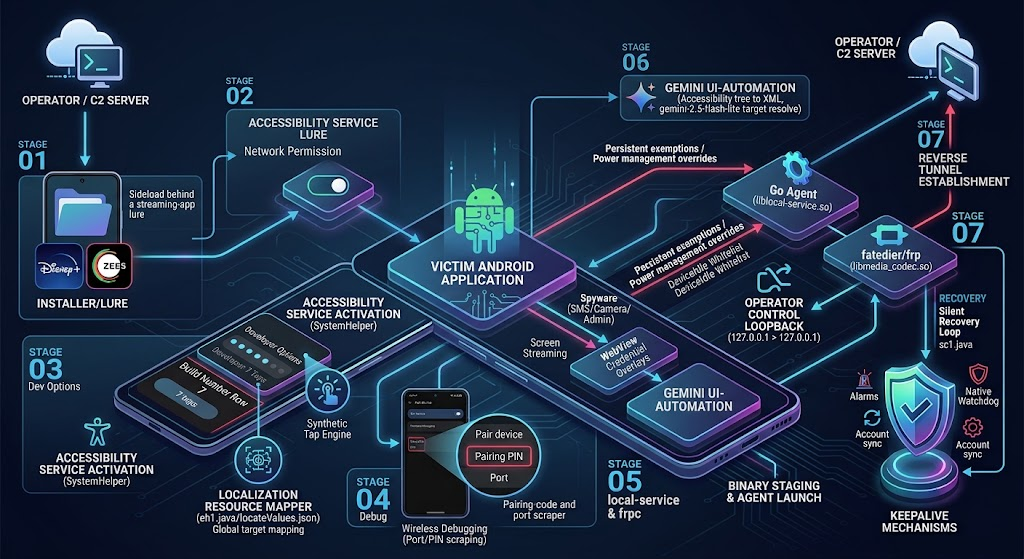
AhnLab recently detailed a new Android malware campaign distributed through apps impersonating a major Korean delivery service. The samples stand out for their use of advanced obfuscation and packing techniques enhanced by AI-assisted tooling, making them far harder for traditional defenses to analyze or detect. Attackers are leveraging generative-AI tools and automated build pipelines to produce polymorphic binaries that change structure between builds, breaking static signatures and enabling large-scale variant generation with minimal effort. At the same time, the malware hides its command-and-control configuration behind compromised but legitimate websites, embedding C2 details inside ordinary pages to evade URL or domain-based blocking. This combination of AI-driven polymorphism and infrastructure hijacking signals a broader trend: mobile malware authors are now integrating AI directly into their development and delivery processes, accelerating both sophistication and volume.
Despite these advancements, both Zimperium’s Mobile Threat Defense (MTD) and Mobile Runtime protection (zDefend) provide full, zero-day detection for all publicly available samples associated with this campaign. Our on-device malware detection engine identifies malicious activity without relying on static signatures or cloud lookups. This makes Zimperium inherently resilient against AI-generated or polymorphic malware variants designed to evade traditional analysis. Because detections occur locally on the device, protection remains effective even when users are offline, on untrusted networks, or operating outside managed corporate environments.
For enterprises, this shift toward AI-augmented mobile malware raises the stakes considerably. Automated variant generation enables attackers to overwhelm signature-based defenses, while impersonation of trusted delivery or logistics brands creates new avenues for credential theft and fraud. The use of compromised legitimate websites as covert C2 channels complicates network-based filtering and increases the likelihood of false negatives. Organizations involved in mobile commerce, payments, logistics, or customer-facing services face heightened risk as attackers target not only consumers but also the broader supply chain that underpins mobile transactions.
The AhnLab report highlights how quickly the mobile threat landscape is evolving. Attackers are using AI not just to scale phishing or social engineering, but to transform how malware is built, obfuscated, and deployed. In this environment, effective defense requires on-device detection and continuous threat intelligence. Zimperium’s dynamic detection engine is already delivering zero-day protection against all known samples of this campaign, demonstrating that even AI-powered malware can be stopped before it compromises users or enterprises.